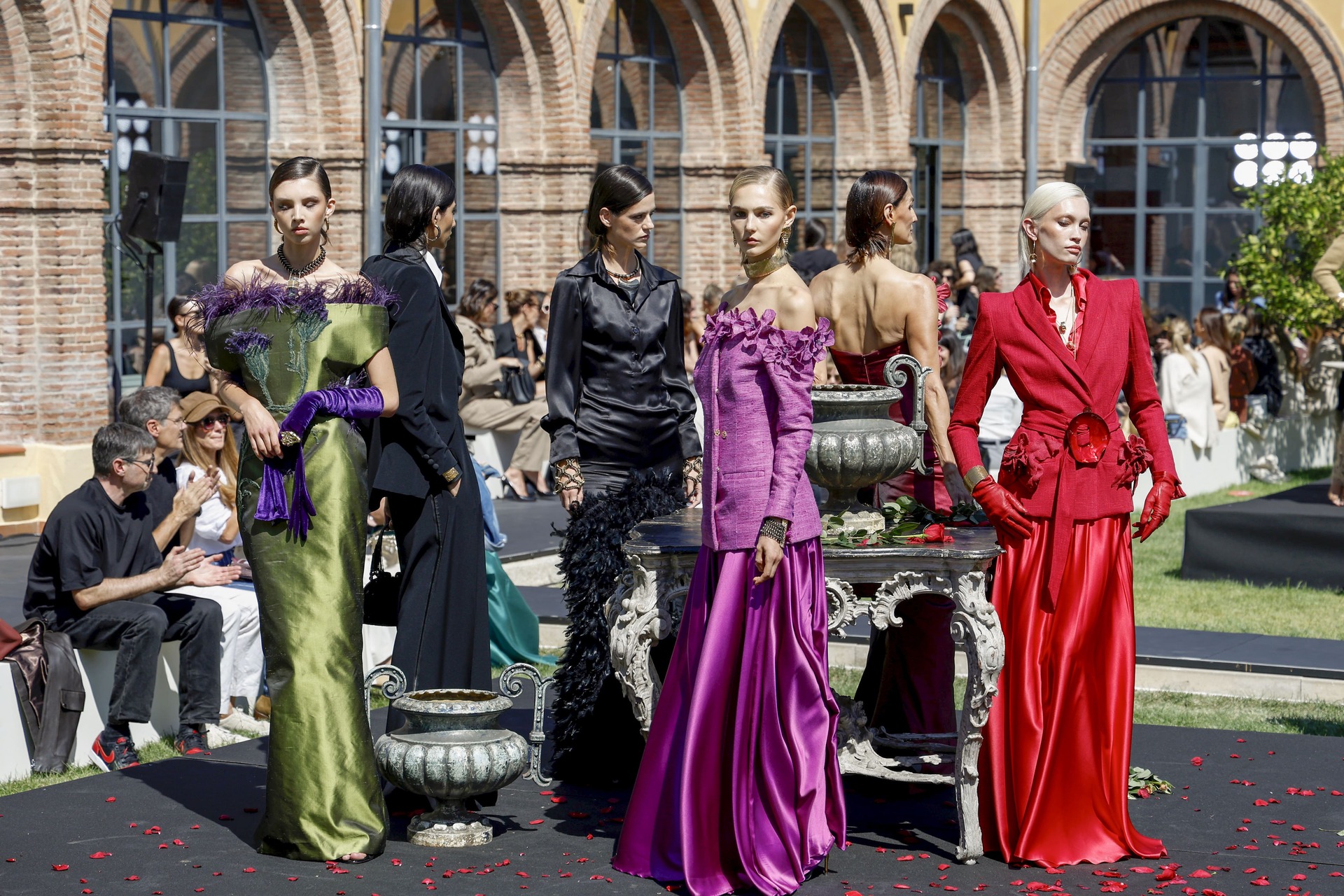
Before it becomes a finished garment, an idea passes through many hands. There are fabrics spread out on a table, patterns being adjusted, pins, fittings on the body, and decisions that sometimes arise from an almost imperceptible gesture. The atelier is the place where design ceases to be intuition and begins to acquire volume, proportion, and character.
Life inside the atelier Our conversation focuses on Paloma Álvarez and Juanjo MánezHow a garment is born, what happens between the sketch and the first fitting, how designers and artisans interact, and what role space, hands, and time play in the final result. A look at the Malne universe from the place where creation, craft, and human connection coexist every day.
When you enter the atelier each morning, what is the first thing that usually gets going: an idea, a fabric, a pattern, a conversation?
First and foremost are our clients. The delivery schedule and the supervision of its production. If we are in the period of fully immersing ourselves in the collection, we like to talk amongst ourselves, to see how far we've come in terms of the artistic message, colors, fabrics…
To what extent does physical space influence your design process and the decisions you make about a garment?
We need several things: a spacious and bright room, preferably painted a light white and surrounded by the selected fabrics. We prefer to wear black or white so as not to visually interrupt the focus with outfits that might distract us. It is, in a way, something almost religious.. The sanctuary, the inspiration, the drawing materials, the photos, the fabrics, and the two of us, working in the temple.
In an atelier, many hands and many crafts coexist. How does one of your ideas transform from the first sketch until it begins to acquire volume, structure, and presence on the body?
The idea begins to take shape after having a technical conversation with the workshop manager, who is an exceptional pattern maker. He is responsible for translating what we tell him into a pattern, with instructions and fabrics already selected.
This person creates the pattern and cuts the fabric, which is then passed on to the seamstresses and tailors. Some pieces are also embroidered or decorated with other crafts. This year, we commissioned a woolen piece, entirely hand-knitted by an artisan in Málaga.
How important are seemingly small moments—a test, a correction on the mannequin, a conversation around the table—within the creative process?
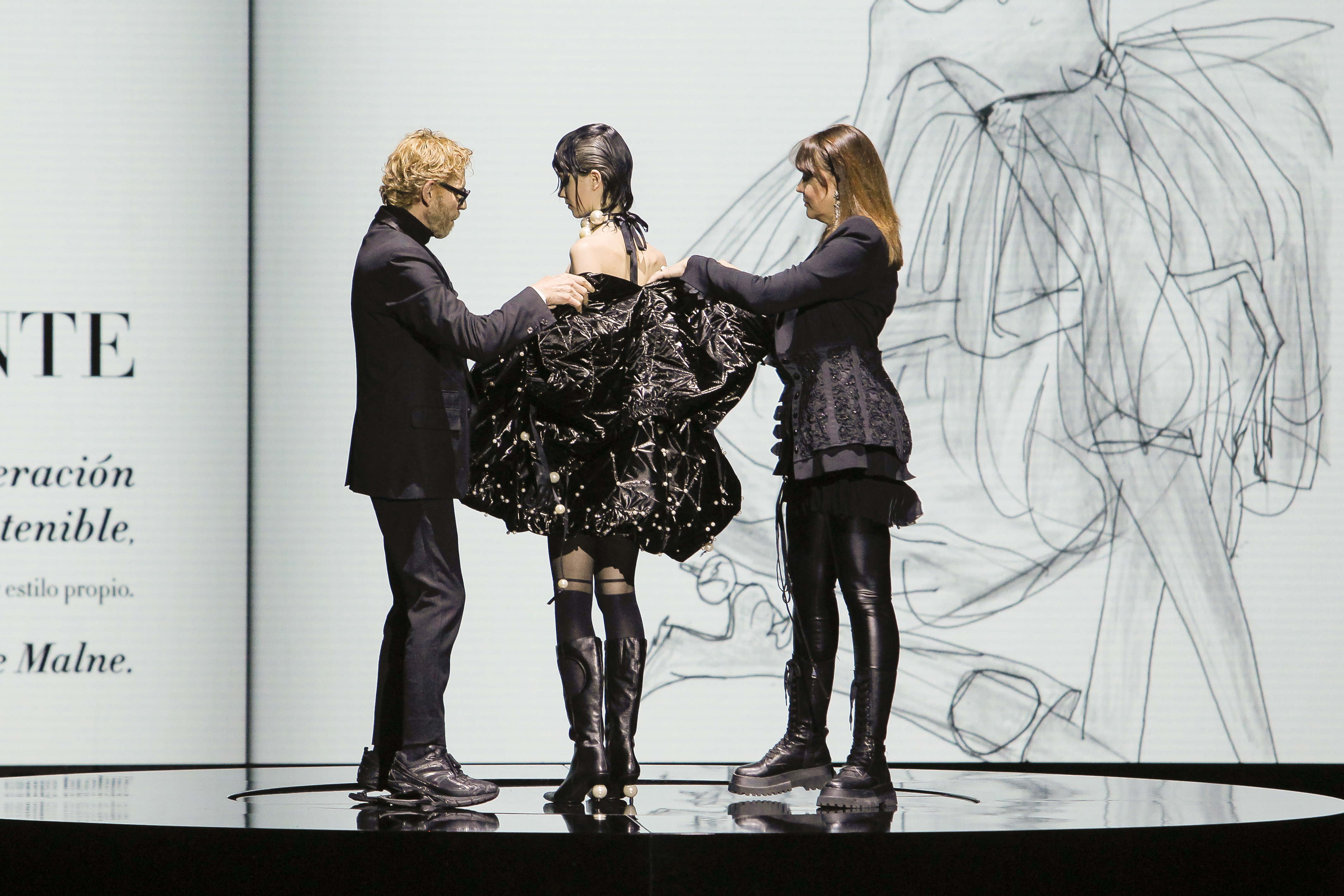
After pattern making and cutting, the garment pieces are basted and It is now under our supervision.: «Have we managed to materialize what we have in mind?»"Most often, we make some length adjustments. In addition to pattern design, we also do moulage. Juanjo and I participate in that process along with the workshop manager.".
An important step is to try on a piece on a model. It's exciting to see how the garment comes to life.
If someone could observe a whole day of work without intervening, what do you think they would understand about Malne that is difficult to explain just by looking at a finished garment?
If someone were to observe us, they would understand that fashion is an art.