The precision of a garment is born when the hand knows how to listen to the body before drawing the first line.
Even before the fabric touches the skin, before the first basting stitch and the first mirror, there is a gesture that decides how a bride will walk on the most photographed day of her life. That gesture is unsigned, unseen, and yet it underpins everything else: it is the tracing of the pattern directly onto the real silhouette, without pre-existing molds, without inherited sizes, without shortcuts. It is what in the great European ateliers is known as freehand pattern making, and constitutes the invisible boundary that separates a made-up dress from a truly inhabited dress.
At Malne We understand it this way: a bride doesn't dress up, a bride is interpreted. And that interpretation begins long before the embroidery, the lace, or the train; it begins at the exact moment when a hand draws on the body what no industrial algorithm can predict.
Two opposing ways of constructing a dress
The difference between a mass-produced wedding dress and one made by haute couture It is at the starting point:
- The industrial pattern is based on an average. A size 38 is a statistical abstraction constructed from thousands of bodies. No real bride exactly matches that average; she's just close enough to fit into the dress.
- The freehand pattern is based on an exception. That bride, that torso, that slightly higher shoulder, that hip with its particular slope. The dress doesn't approximate: it fits perfectly because it's born from a specific body.
That is the logic that defines the custom-made wedding dresses authentic: not the promise of a few tweaks on a pre-existing mold, but the complete construction of the piece based on the actual anatomy of the person who will wear it.
The hand that draws before cutting
The freehand pattern making It is, in essence, a craft of gesture. The pattern maker draws directly onto the body—or onto a mannequin tailored point by point to the client—the lines that will later be transferred to the fabric. There is no pre-made template, no pattern saved in a digital file. Each dress is, from its very first stroke, a unique object.
At this point, two elements that rarely coexist in contemporary fashion intersect: technical rigor and artistic intuition. The pattern maker reads the silhouette like a sculptor reads stone. They know where the fabric should give and where it needs to hold, where a dart provides structure and where it betrays the body, how to make a neckline lift from the body just enough to suggest without revealing. This understanding isn't taught in a manual; it's inherited in an atelier.
That's why the handmade wedding dresses Those born from this process have something that is perceived even before they are identified. It's not the fabric, it's not the embroidery, it's not the brand. It's the immediate feeling that that dress could only belong to that woman.
What exactly does "presence" mean?«
It's a word that's used a lot but rarely defined. In the context of weddings, however, it's an absolutely concrete phenomenon, made up of details that are noticeable even if they aren't named.
- The perfect drape of the skirt when turning, without parasitic folds that need correcting in every photo.
- A neckline that stays in place throughout the entire ceremony, without a single discreet adjustment gesture, without tugging, without straining your neck to hold it up.
- A back that looks longer and a more relaxed neckline, because the bodice line has been drawn respecting exactly the actual length of the torso.
- A natural step, not conditioned by a skirt that squeezes where it shouldn't or that flies where it should weigh.
- Arms that move freely, because the armhole—that technical detail that the industry usually resolves by approximation—has been calculated based on the actual movement of the client's shoulder.
None of this is by chance. All of this is built on the pattern-making table, weeks before the appointed day. haute couture wedding dresses They are recognized, above all, by this silent accumulation of successes.
Time as a material
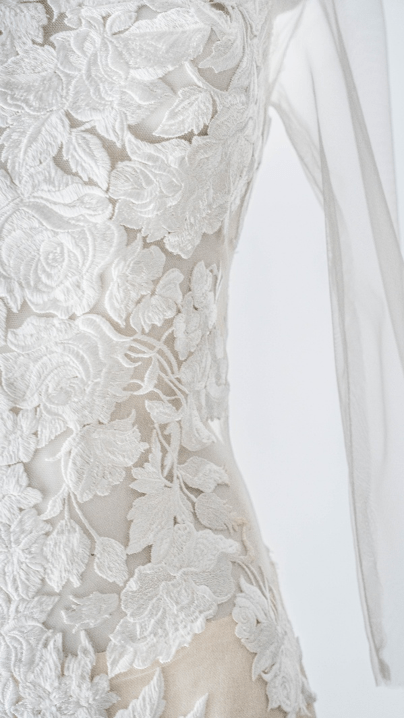
There is a dimension, less technical and deeper, that defines dresses constructed in this way: time.
Freehand pattern making takes weeks, sometimes months. It requires fittings, adjustments, long conversations, silences in which the designer observes how a bride moves. It requires raw fabric, basting, volume tests before touching the final fabric. That time is not a cost: it is the essential material of the work. It is, in many ways, what the client is really buying when she approaches the signature bridal fashion.
Because what is ultimately delivered is not just a dress. It is a particular story—hers—translated into the language of fabric. A piece designed with a name, not a size.
And like every story, hers also begins with an encounter: a first date in the atelier, without commitment and without catalogs, in which one listens, observes and imagines what does not yet exist.
The bride who chooses to be interpreted
The brides arriving in Malne They often have something in common, even though they come from different worlds. They're looking for something that the conventional market doesn't offer. They don't want to walk into a store and choose from available options. They want to walk into a studio and participate in the creation of a piece that didn't exist before them.
It's a different way of understanding luxury. And also, paradoxically, a freer one: when the dress is constructed from a freehand pattern, everything else—the neckline, the drape, the volumes, the fabrics, the embroidery, the unique details—ceases to be a limitation and becomes open territory.
The exact size, then, isn't a matter of centimeters. It's a way of affirming that a bride has the right to a dress designed specifically for her. That her presence deserves a unique design. That on the day she walks down the aisle, to the garden, or wherever she has chosen to get married, she does so wearing something that could only have been hers.
That, and nothing else, is what distinguishes the freehand pattern making: the deeply artisanal and deeply contemporary conviction that dressing a bride is an act of authorship.
And that authorship always begins in the same way: with a woman and a designer, face to face, talking to each other.