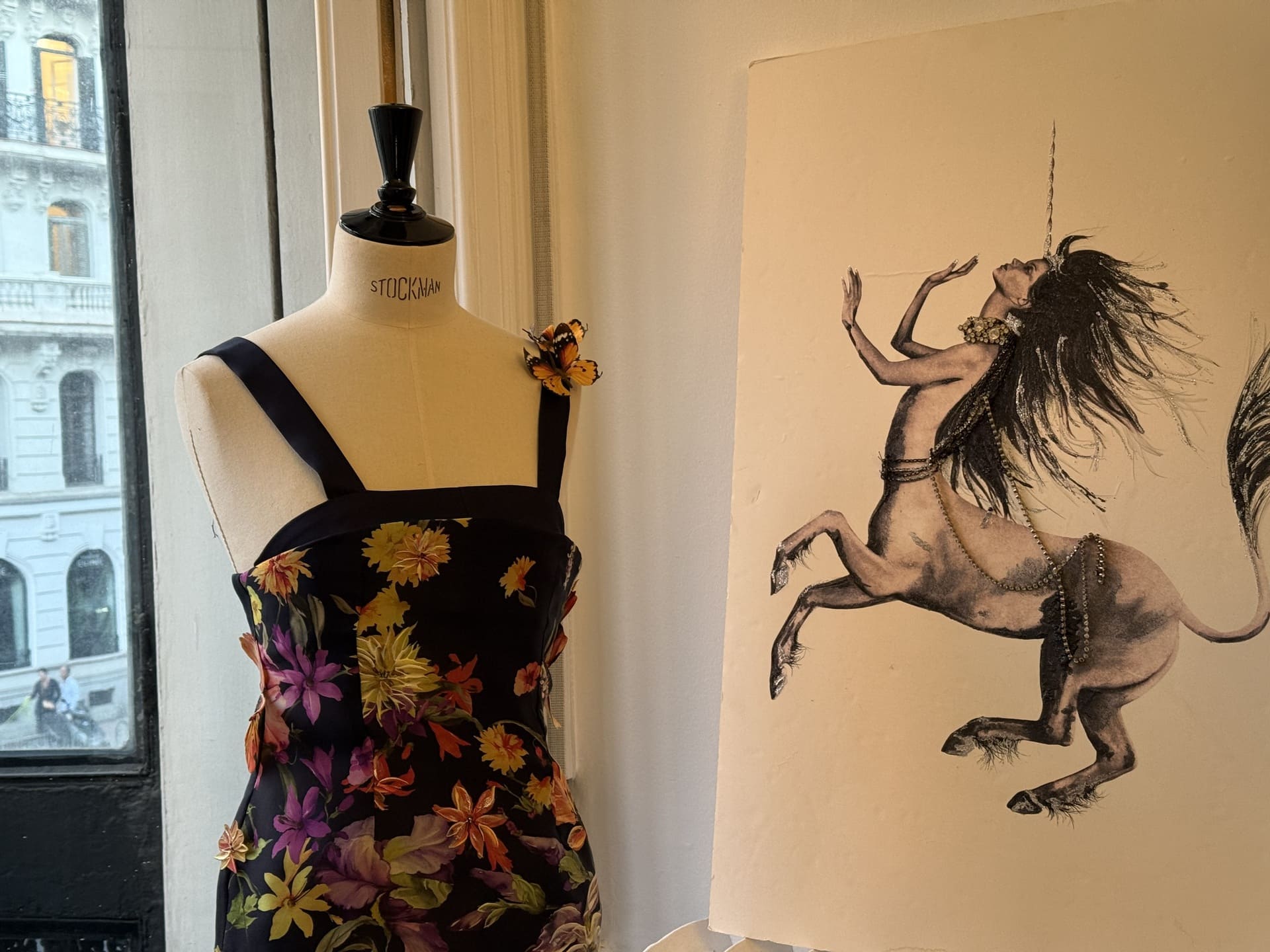
“True luxury isn’t always visible at first glance. Sometimes it’s discovered in a hand-sewn lining, a perfect buttonhole, a fitting that corrects a millimeter and completely changes the way a dress drapes.”
There is a question that comes up frequently in the studio, almost always asked with a mixture of curiosity and wonder: How many hours does it take to make a wedding dress?. The answer rarely fits into a single figure, because a haute couture piece isn't born from a mechanical sum of tasks, but from a sequence of decisions, hands, tests, and sensibilities. Malne, Time is not understood as a wait; it is understood as an essential part of the garment's value. This perspective is part of a brand defined by haute couture, the designers' personal attention, and artisanal work that shuns industrial logic.
Time as an invisible raw material
In an era dominated by immediacy, Working slowly might seem almost unusual. In our world, however, it's a form of respect. Respect for the female body, for the craft, for the beauty of a well-made garment, and for the experience of those who come to us. Malne was born precisely from this desire to move away from impersonal and fast-paced models, to recover the artistic essence of the atelier, and to return fashion to its most intimate and precise dimension.
When someone asks How long does it take to make a bridal gown, But she's really asking about something deeper: how long does it take to transform an intuition into a silhouette, a conversation into a garment, an idea into a tangible emotion? And the truth is, that time varies because each dress responds to a specific woman, a specific gesture, a specific story.
Many hours have already passed before sewing.
One of the biggest misconceptions about designer bridal fashion is that the clock starts ticking when the needle comes into play. In reality, the dress clock starts long before.
It begins in the conversation with the designers, in the observation of the body, in the way of walking, in the energy that a client gives off, in the way she imagines that day and in what she wants to express without needing to verbalize it completely. In Malne, that personal attention is part of the experience and of the very meaning of creation.
From there come the drawings, the proposals, the selection of fabrics, the definition of proportions, the choice of the right white, the construction of the pattern, and the trial toile. All of that territory belongs entirely to the creative process, even though the final assembly hasn't started yet. These are hours that aren't always noticeable from the outside, but they underpin everything else.
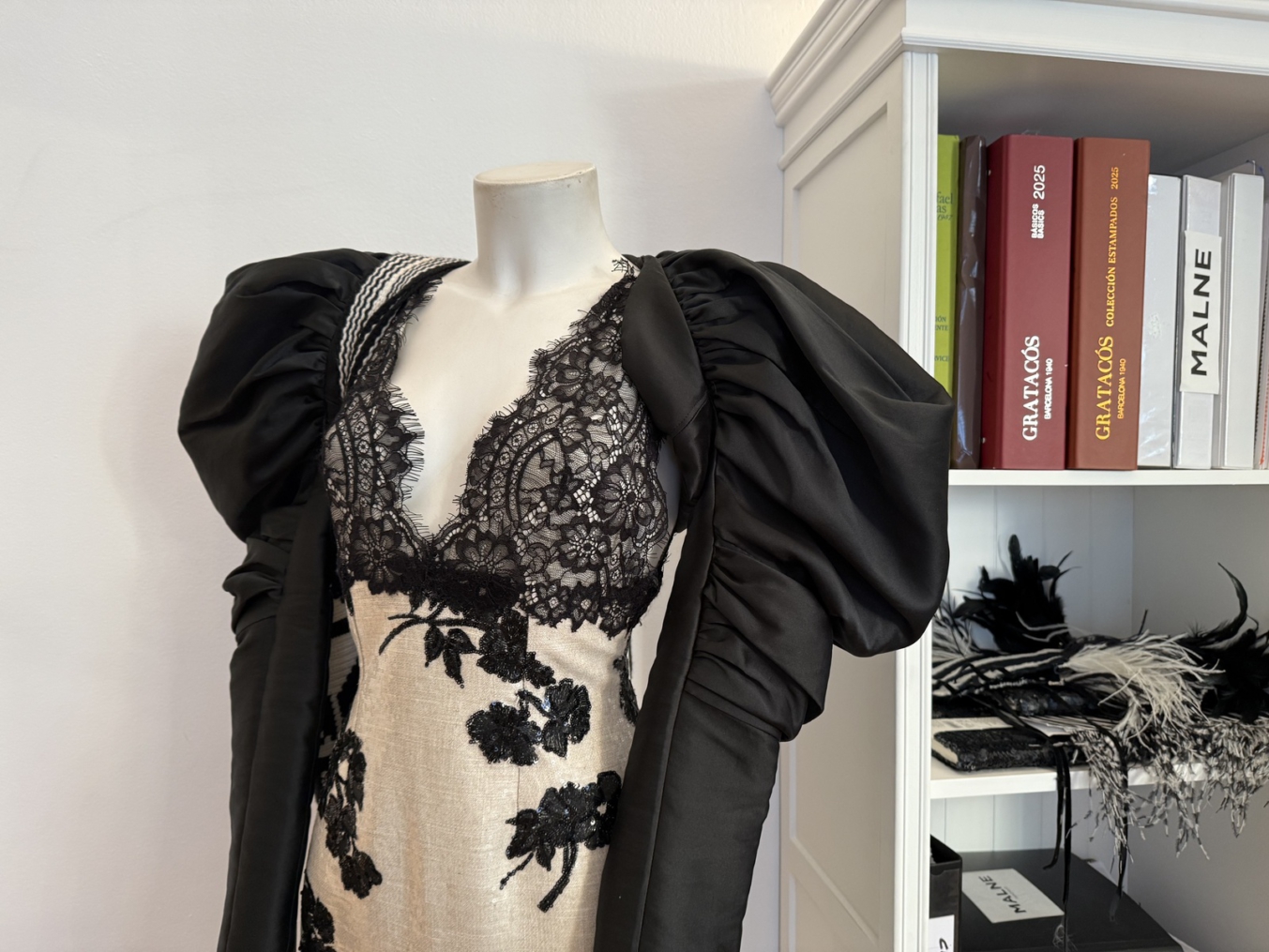
The architecture of the invisible
Some dresses impress at first glance. Others reveal their true nature upon closer inspection.
The internal structure, the invisible corset, the weight distribution, the way the lining moves with you, the clean lines of an interior seam, or the precision of a hand-finished detail are all part of that silent language of luxury. These are not secondary details. They are the core that allows a garment to possess presence, lightness, firmness, and harmony all at once.
That interior architecture It demands a way of working that doesn't allow for haste. Each layer must interact with the next. Each element has an aesthetic function, but also a physical one. What appears natural from the outside is almost always the result of many invisible adjustments.
What really takes up the hours of a dress
When a client wants to know How long does it take to have a dress ready?, The most honest thing to do is explain how that time is spent. It's not spent on a single operation, but on a constellation of meticulous tasks that build the piece from the inside out. Among them:
- The initial meeting with the designers, where the personality, silhouette and context of the dress are interpreted.
- Creating the custom pattern, drawn from scratch for a specific body.
- The test cloth, which allows you to decide on proportions, volumes and corrections before the final fabric.
- The search for the right fabric, including shades of white, transparencies, weight and drape.
- The construction of the internal structure, with internal corsets, reinforcements and invisible supports.
- The artisanal finishing work, such as hand-sewn linings, covered buttons, buttonholes, trims and internal bias binding.
- Embroidery, flowers, or appliqués, made with the slowness and care that haute couture demands.
- The successive tests, where the dress is refined until it is in perfect harmony with the person who will wear it.
That set of hours is what makes the garment unique. Not by chance, but because each phase contains decisions that cannot be standardized.
Time is also a form of ethics
Producing locally, avoiding surplus, working without the logic of inventory, and upholding craftsmanship as a genuine part of a garment's value implies accepting that certain things cannot be rushed. Slowness, in this context, is not a romantic pose. It is a natural consequence of doing things well.
That's why each dress contains more than just design and technique. It contains a biography. The hand that made it possible, the conversations that guided it, the woman who will ultimately inhabit it. And that sum of time, knowledge, and presence is what makes it so difficult to compare an atelier piece with any other type of product.
What remains when the hours are no longer counted
Perhaps the initial question shouldn't be answered with a number. Perhaps the real answer to How many hours does it take to make a wedding dress? Let this be: the necessary elements for an idea to become a piece with soul, structure, and truth.
At Malne, every hour spent on a hand-lined garment, a perfect buttonhole, an extra fitting, or an invisible alteration is part of a promise of excellence. The dress is seen in an instant. The work behind it lasts much longer.
And there, precisely there, lies its hidden value.